

Reading time: approx. 5 minutes
Nobody asks what day it is on the Mongolian steppe.
This isn't because time doesn't matter here — quite the opposite. Nomads possess a sensitivity to time that most city-dwellers have long forgotten. They simply measure it differently: not by numbers on a calendar, but by the shift in wind direction, the deepening green of the grass, the restlessness or calm of the herd.
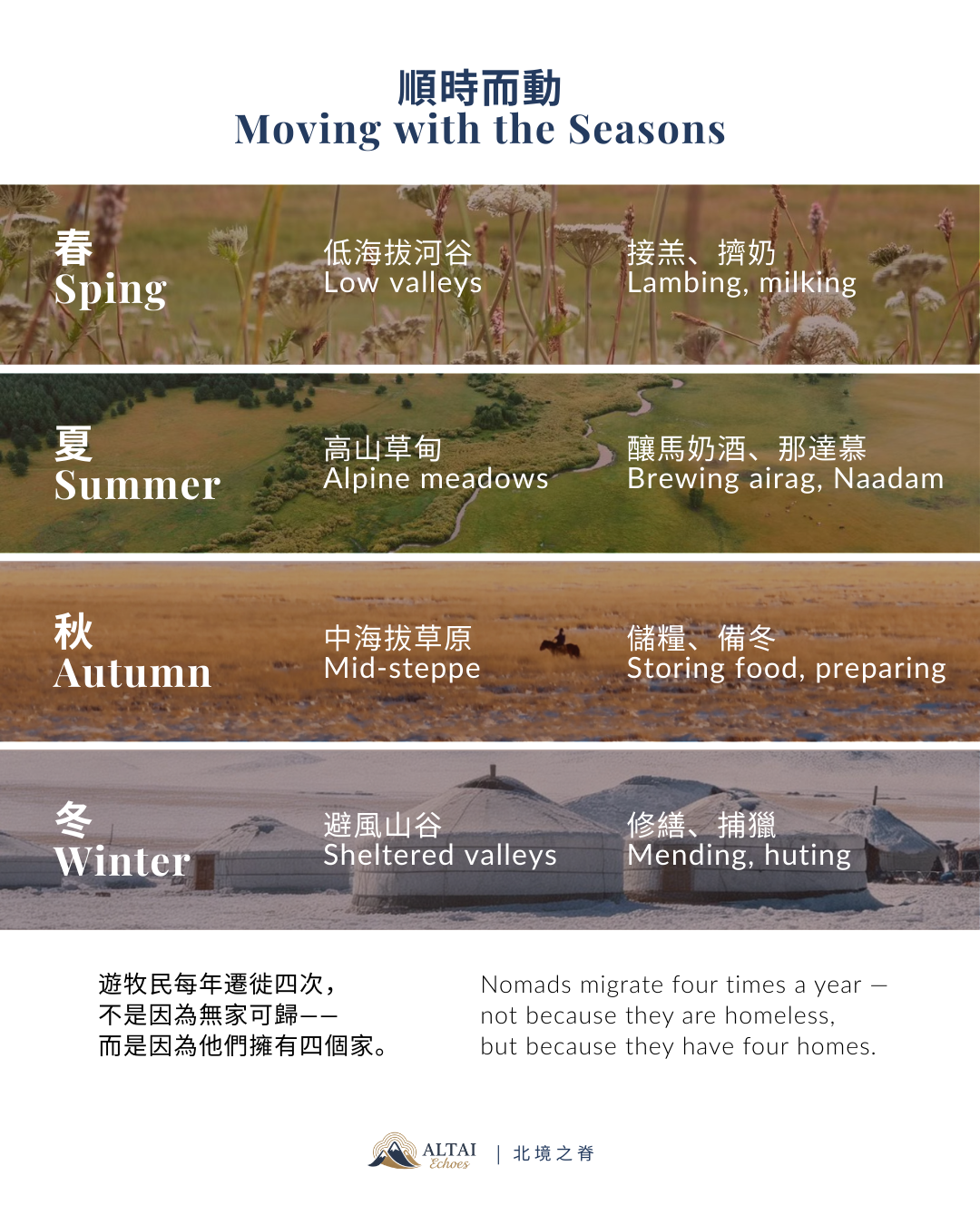
For millennia, the peoples of this high plateau have lived in complete synchrony with nature's rhythm. They migrate four times a year, moving between spring, summer, autumn, and winter pastures. This is not wandering — it is a profound order, an ecological intelligence more precise than any urban planning system.
Spring: The Earth's First Breath
In April, when the steppe's snow begins to melt, herders know: it is time.
They call this period the return of "Nutug" — a Mongolian word meaning "homeland," but carrying a deeper resonance: the moment when the land begins to breathe again. Ewes give birth. Grass turns from brown to tender green. Gers are dismantled from their winter shelters and moved to lower spring pastures.
Spring is the most fragile season of the year. Newborn lambs require constant care; a sudden cold snap can undo weeks of careful tending. Nomadic women keep near-sleepless vigil over every new life. This meticulous care for vulnerability reflects a core value of nomadic culture: reverence for nature is never abstract — it lives in every concrete act.

Summer: The Steppe's Most Generous Gift
June through August — the golden age of the grasslands.
Wildflowers paint the meadows in purple and yellow. Horse herds roam freely across alpine pastures. This is the season for brewing Airag — fermented mare's milk — poured into leather pouches and stirred hundreds of times each day, slowly fermenting in the summer warmth. A good batch of Airag requires the collaboration of an entire family.
Naadam takes place in summer — wrestling, archery, and horse racing. These "three manly games" are not merely competitions; they are rituals of community cohesion. The winner earns not just glory, but the trust and recognition of the entire community.
The ger door always faces east — to welcome the morning light, and the traveler who comes from afar.

Autumn: The Golden Farewell
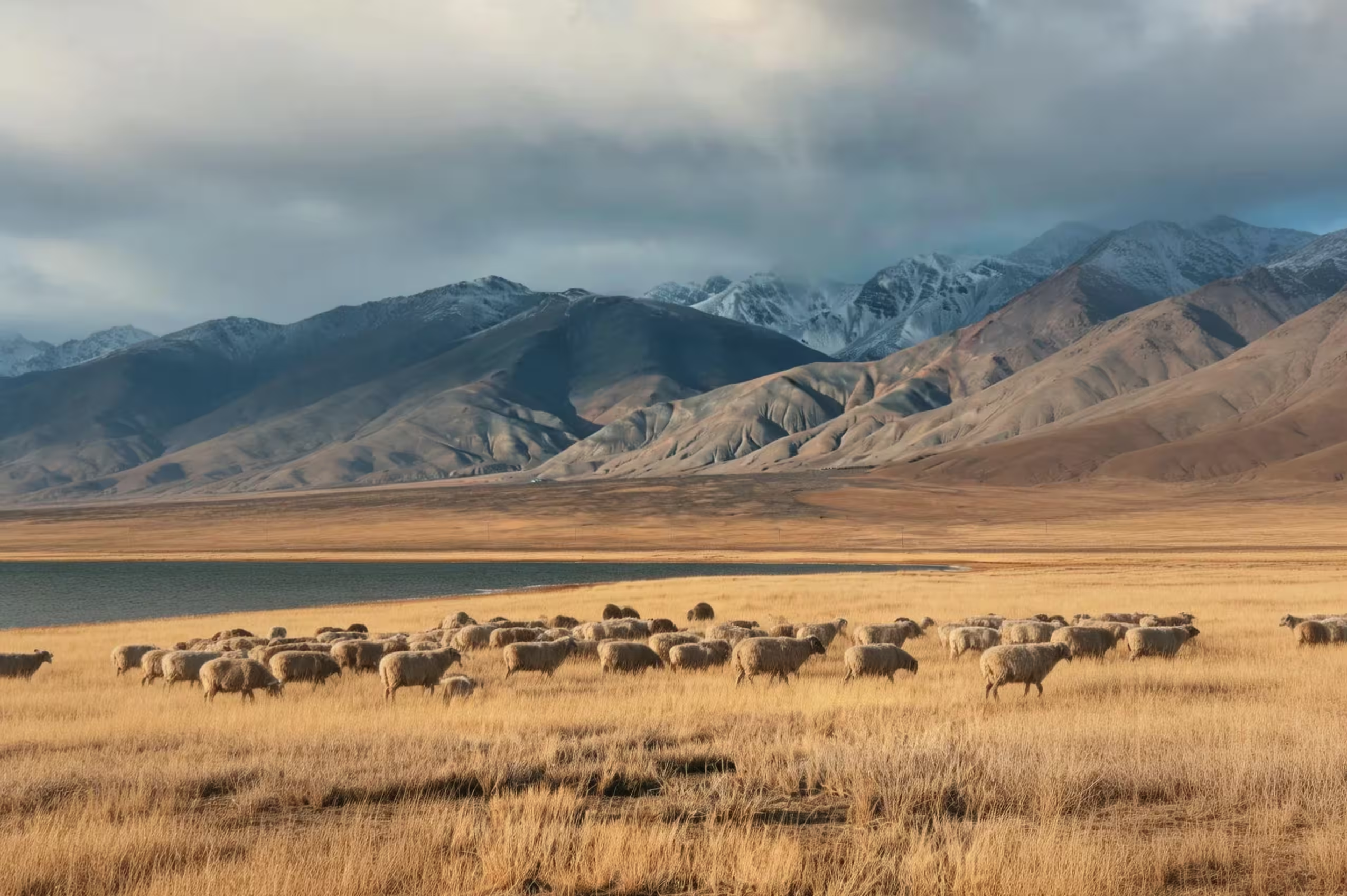
In September, the steppe turns gold and the air becomes crystal clear.
Low-angle sunlight paints the grasslands amber. Migratory birds begin to gather and head south. Herders enter the year's busiest preparation period — storing food, repairing harnesses, reinforcing the ger walls against the coming cold.
Horses are at their strongest now. Herders make one last long ride across the pastures, measuring the boundaries of the land and the harvest of the year.
Autumn light is a photographer's dream — every moment a carefully composed painting. Sometimes, beauty itself is a way of saying farewell.
Winter: The Earth Sleeps, But Life Continues
In November, the first blizzard seals the valleys. Temperatures plunge to -30°C.
What outsiders perceive as brutal hardship, nomads regard as the season that tests wisdom most. Ger walls are layered with thick wool felt. The stove burns without pause. Men ride out with golden eagles into the white silence, scanning for fox tracks across the snow. Women cut holes in frozen lakes, waiting patiently for cold-water fish to bite.
Winter is the hunting season on the steppe.
No migrations now — but a different rhythm of survival. Not waiting for spring, but living with winter, drawing sustenance from a land that only appears asleep. This is the oldest resilience of nomadic culture: the ability to thrive, not just survive, when the world is at its coldest.

Winter: The Earth Sleeps, But Life Continues
In November, the first blizzard seals the valleys. Temperatures plunge to -30°C.
What outsiders perceive as brutal hardship, nomads regard as the season that tests wisdom most. Ger walls are layered with thick wool felt. The stove burns without pause. Men ride out with golden eagles into the white silence, scanning for fox tracks across the snow. Women cut holes in frozen lakes, waiting patiently for cold-water fish to bite.
Winter is the hunting season on the steppe.
No migrations now — but a different rhythm of survival. Not waiting for spring, but living with winter, drawing sustenance from a land that only appears asleep. This is the oldest resilience of nomadic culture: the ability to thrive, not just survive, when the world is at its coldest.
A Forgotten Way of Knowing Time
We live in a world governed by calendars and alarms. We work, rest, and travel on fixed schedules, growing increasingly unable to sense the turning of seasons, the rhythm of our bodies, the conversation with nature.
The nomadic philosophy of the four seasons reminds us: time is not a linear scale, but a cyclical rhythm. Every season carries its purpose. Every migration is a renewal.
When you stand on the Mongolian steppe and watch a family dismantle their ger, load their camels, and prepare to move toward the next pasture, something shifts inside you. You suddenly understand: they are not fleeing anything. They are following something.
A way of life older — and perhaps wiser — than our own.
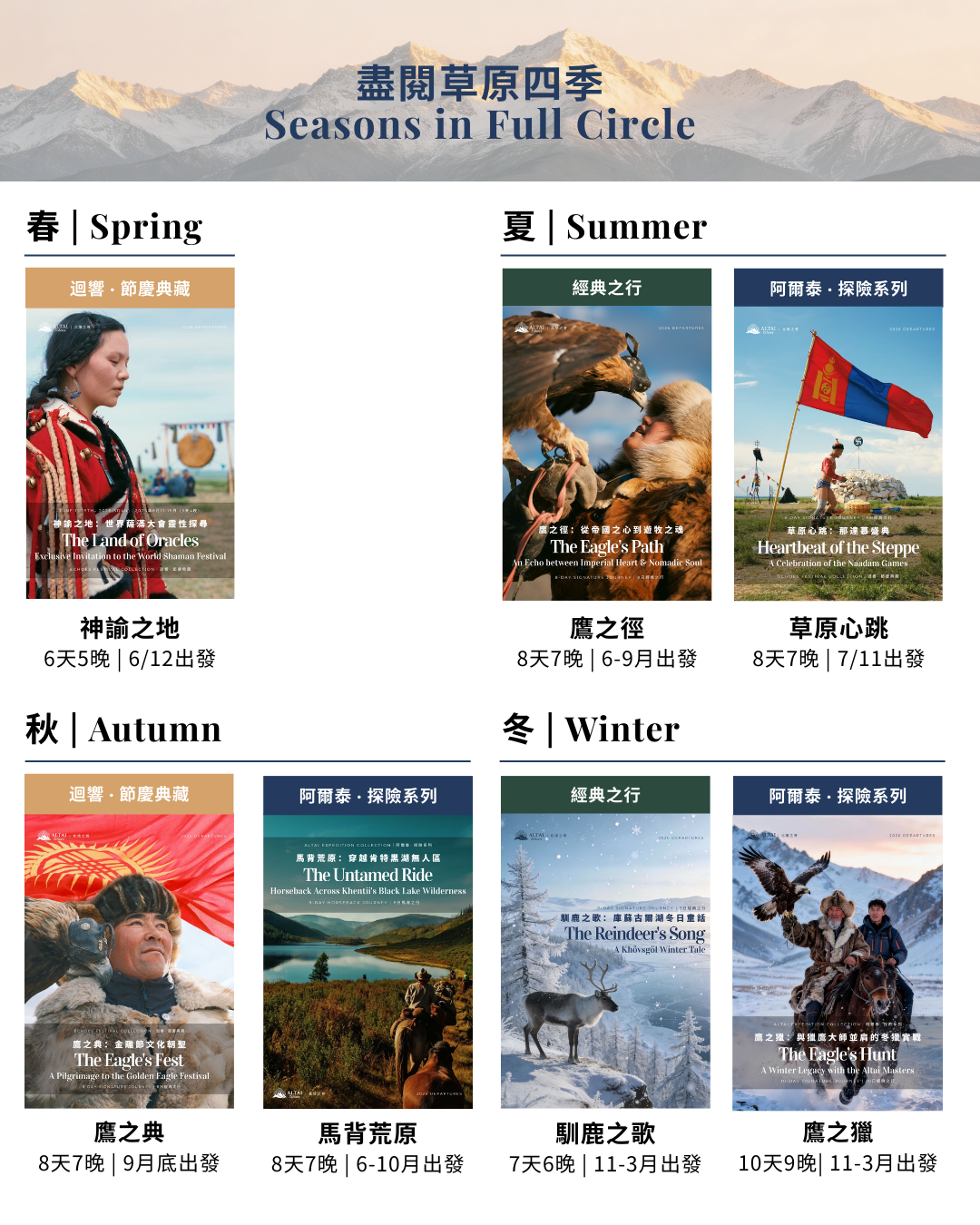
Altai Echoes 2026 departures are now open for booking. Each journey is limited to 8 voyagers, ensuring every guest receives a genuinely immersive experience.