

Most people go to Mongolia for the landscape.
They come back changed by something else entirely.
Mongolia's festivals are not attractions. They are not performances staged for visitors. They are the moments when this land's people reaffirm — in the most ancient ways available to them — their relationship with family, with nature, and with the sky above the steppe.
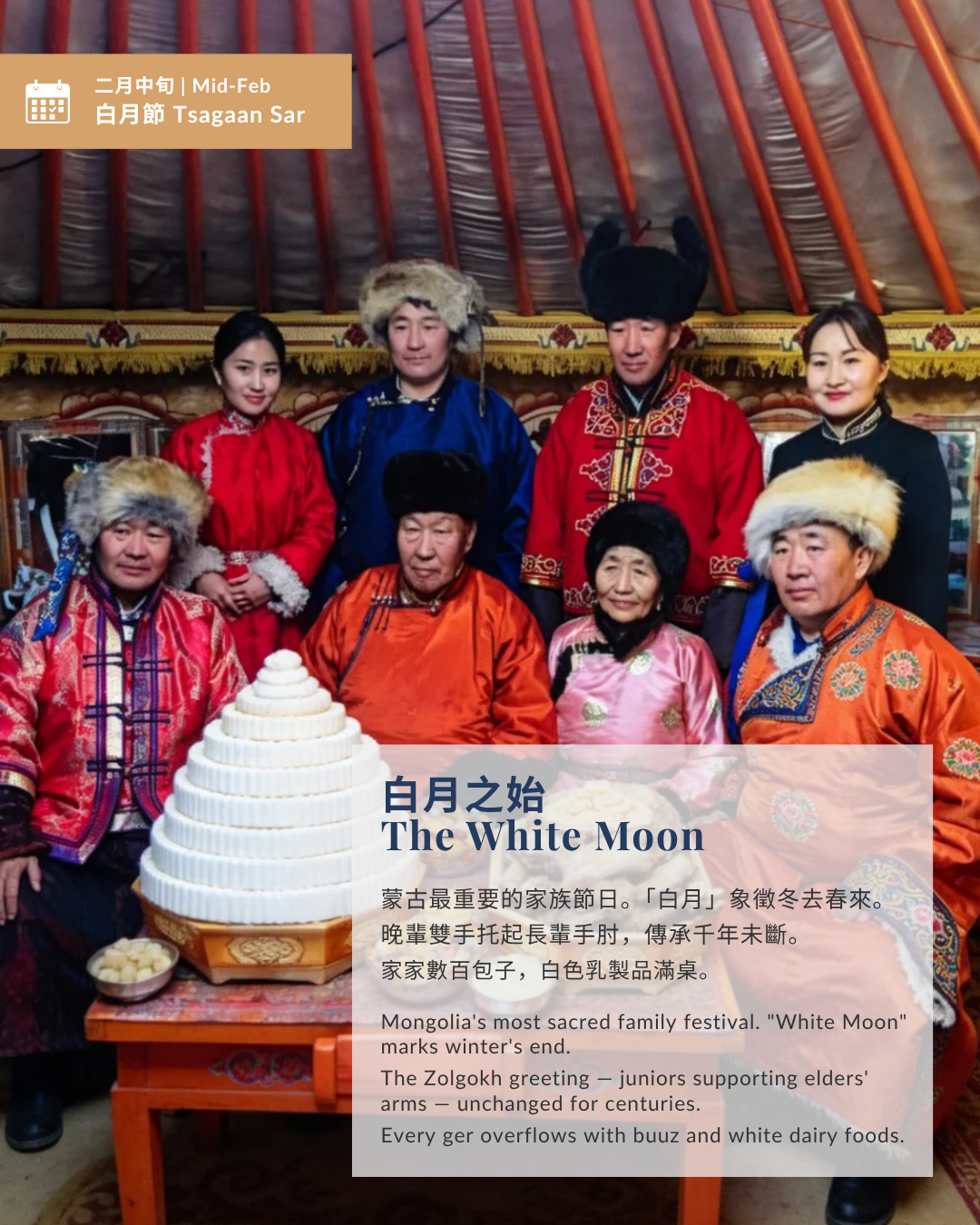
Here are six festivals that reward the traveller who plans with intention.
I · The White Moon
Tsagaan Sar|Mid-February|Nationwide
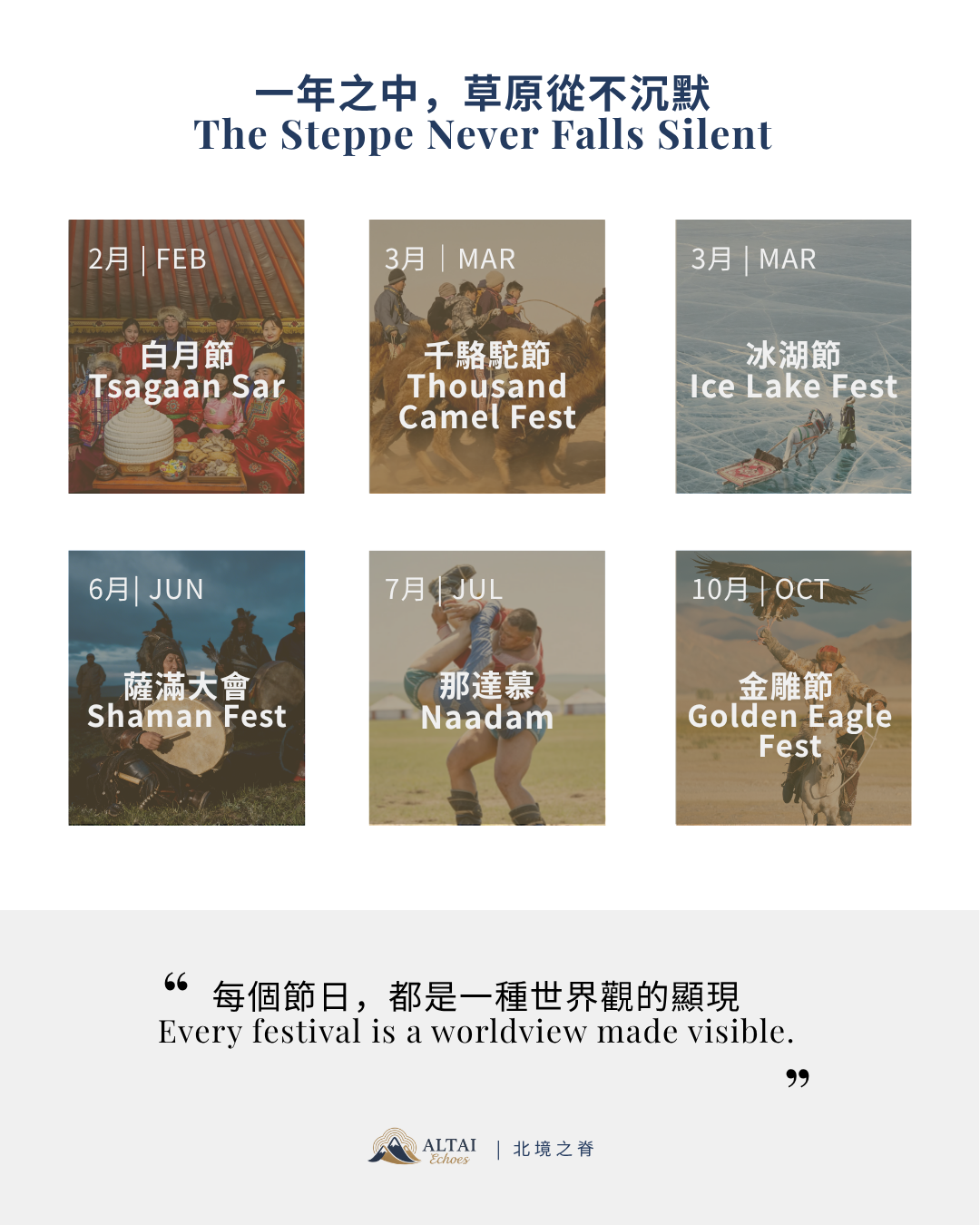
Tsagaan Sar — White Moon — is Mongolia's Lunar New Year, and its most sacred family festival.
The White Moon marks winter's end. In the days before, families gather to make hundreds of buuz — steamed dumplings — a labour of love that fills every ger with warmth and the scent of dough. On the day itself, the Zolgokh greeting is performed: juniors cup their arms beneath their elders' elbows in a gesture of respect unchanged for centuries. It means: I am here. I remember you.
White dairy foods cover every table — cheese, clotted cream, dried curds — symbolising purity and abundance. Temples fill with prayer. Gers fill with laughter and fermented mare's milk.
For the traveller: Tsagaan Sar is intimate and familial. If you are invited into a nomadic family's ger, accept without hesitation. No landmark offers what that table can.
II · The Gobi on Camelback
Thousand Camel Festival|Early March|South Gobi Province
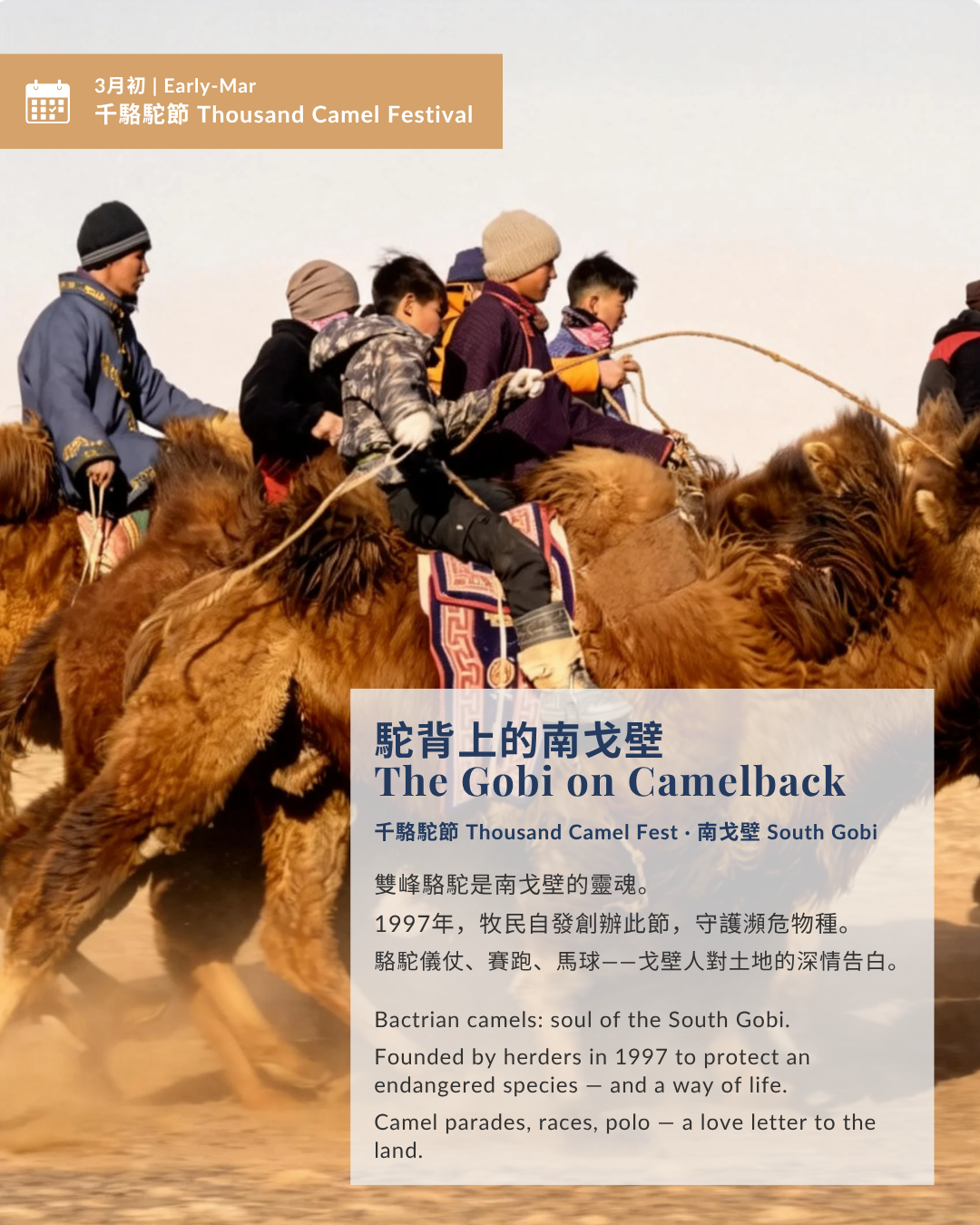
In 1997, the herders of the South Gobi invented a festival.
Their reason was simple and urgent: the Bactrian camel was disappearing. These two-humped animals — capable of surviving at −40°C, going three weeks without water — had been the backbone of Central Asian nomadic life for millennia. The herders' response was not a petition. It was a celebration.
The festival includes camel parades, races, polo matches, and — with characteristic Mongolian wit — a competition for the most beautiful camel. It is a love letter to the land, written in dust and hoofbeats.
For the traveller: The South Gobi is remote and cold in early spring. That difficulty is also its gift — the atmosphere here is entirely unperformed. What you see is real.
III · Ritual on Frozen Water
Khövsgöl Ice Festival|Late March|Lake Khövsgöl
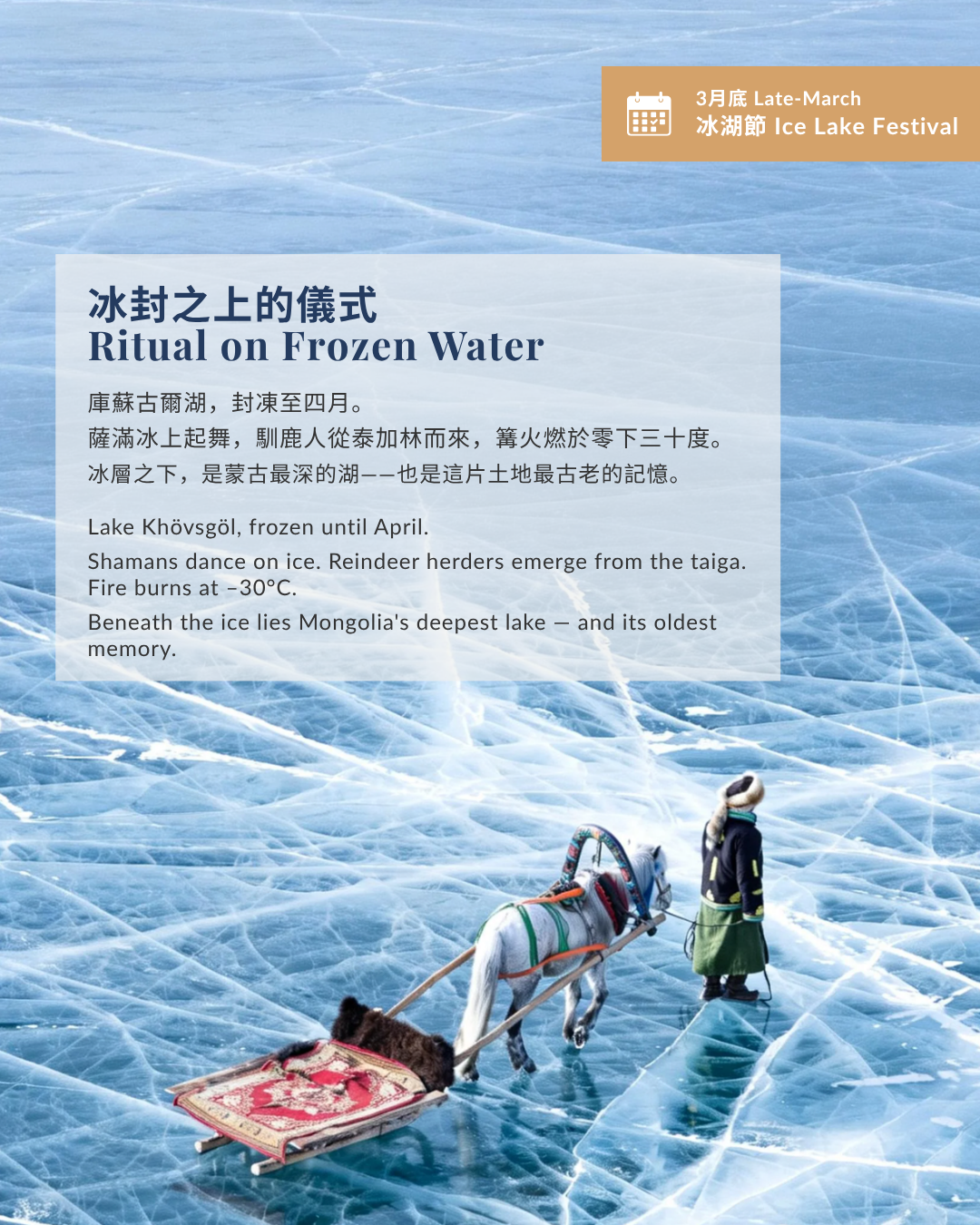
In late March, Mongolia's northernmost lake is still frozen solid — a metre of ice, clear as glass, stretching to the horizon.
On this surface, shamans dance. Reindeer herders emerge from the taiga. Fires burn at −30°C. Horse-drawn sleighs race across the ice while competitors demonstrate traditional archery and shagai — knuckle-bone shooting, a game on UNESCO's Intangible Cultural Heritage list.
Lake Khövsgöl holds 70% of Mongolia's freshwater and is one of the world's purest lakes. For the Darkhad and Tsaatan communities who have lived beside it for generations, it is sacred ground.
For the traveller: Standing on transparent ice, surrounded by snow-draped taiga, watching fire burn in temperatures that should extinguish it — this experience needs no embellishment. It is complete as it is.
IV · All Things Hold Spirit
World Shaman Festival|June 12|Ulaanbaatar
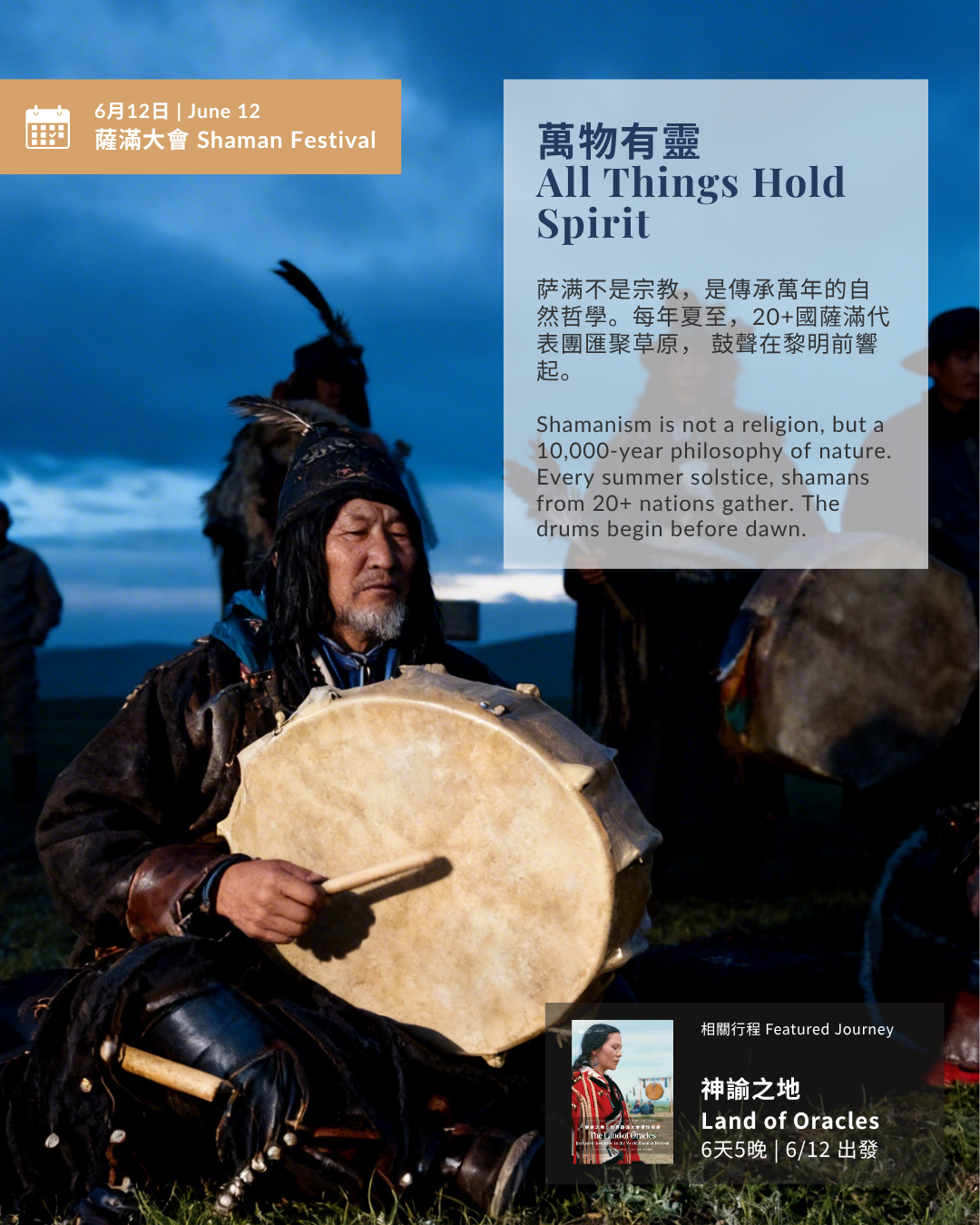
Shamanism is not a religion.
This is the most important thing to understand before you attend.
It is a philosophy — practiced for over 10,000 years — built on the belief that all living things carry spirit, and that the relationship between humans and nature must be actively maintained. Every summer, shamans from more than twenty nations gather on the steppe outside Ulaanbaatar. The drums begin before dawn. The ceremonies unfold in morning light.
This is not performance. It is practice.
For the traveller: You can attend with a camera and observe from the outside. Or you can arrive with genuine openness and let the experience find you. Both are valid choices. Only one will stay with you for years.
V · Three Manly Games
Naadam|July 11|Nationwide
On July 11th — Mongolia's National Day — the country stops, and the steppe comes alive.
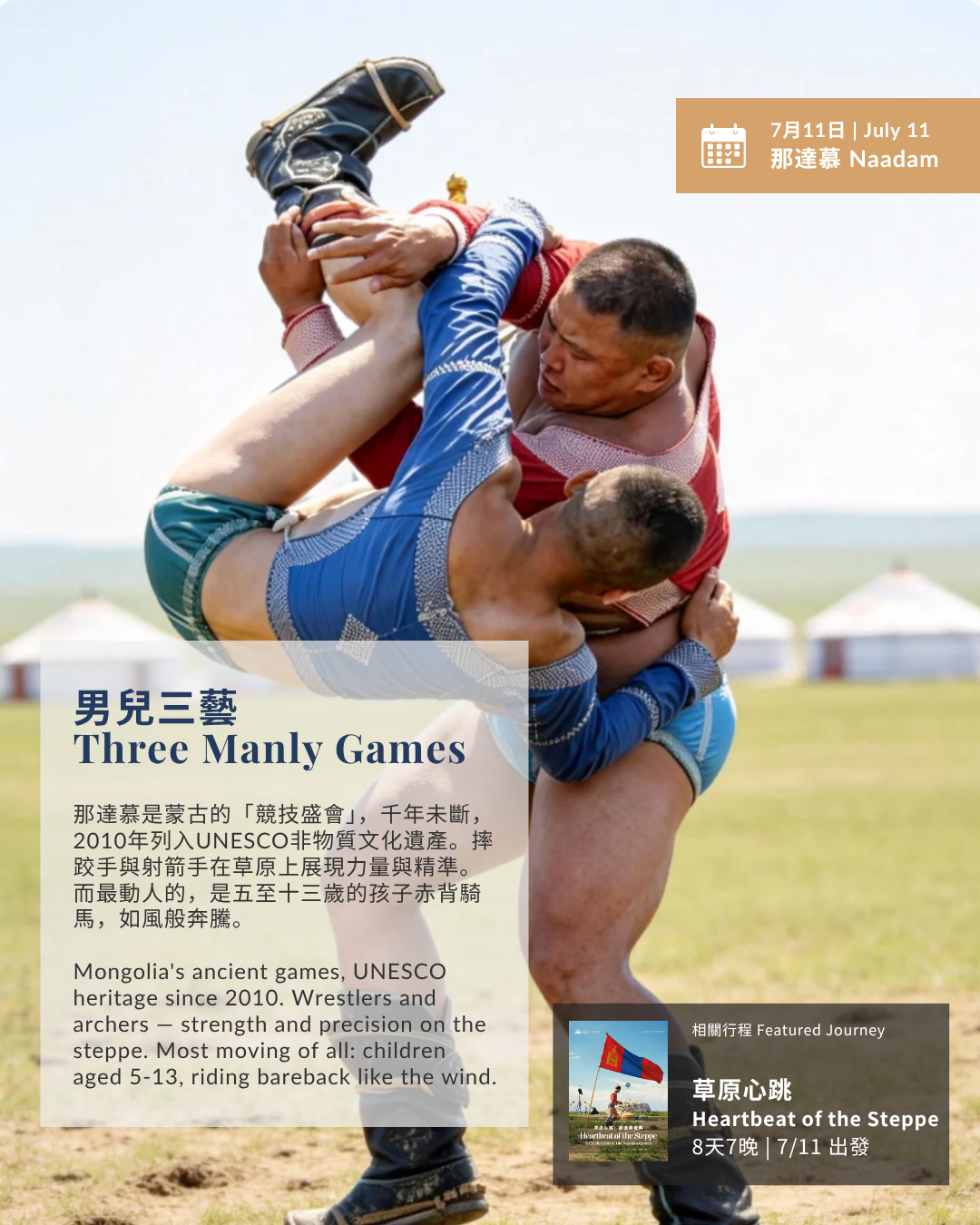
Naadam, meaning "games," is Mongolia's oldest festival, inscribed on UNESCO's Intangible Cultural Heritage list in 2010. Its three competitions — wrestling, archery, and horse racing — trace their origins to Genghis Khan's military era and have continued unbroken for centuries.
Wrestlers in traditional costume demonstrate strength and technique. Archers draw ancient-style bows with precision that silences crowds. And most moving of all: children aged five to thirteen, riding bareback across dozens of kilometres of grassland. At the finish line, their faces are not tense — they are calm. This is something they have always known they could do.
For the traveller: Naadam is the one festival that requires advance planning — July is peak season and accommodation books out months ahead. Choose a small-group journey and seek out a local Naadam beyond the capital. The atmosphere is purer, closer to what this festival has always been.
VI · Partners of the Sky
Golden Eagle Festival|Early October|Bayan-Ölgii Province
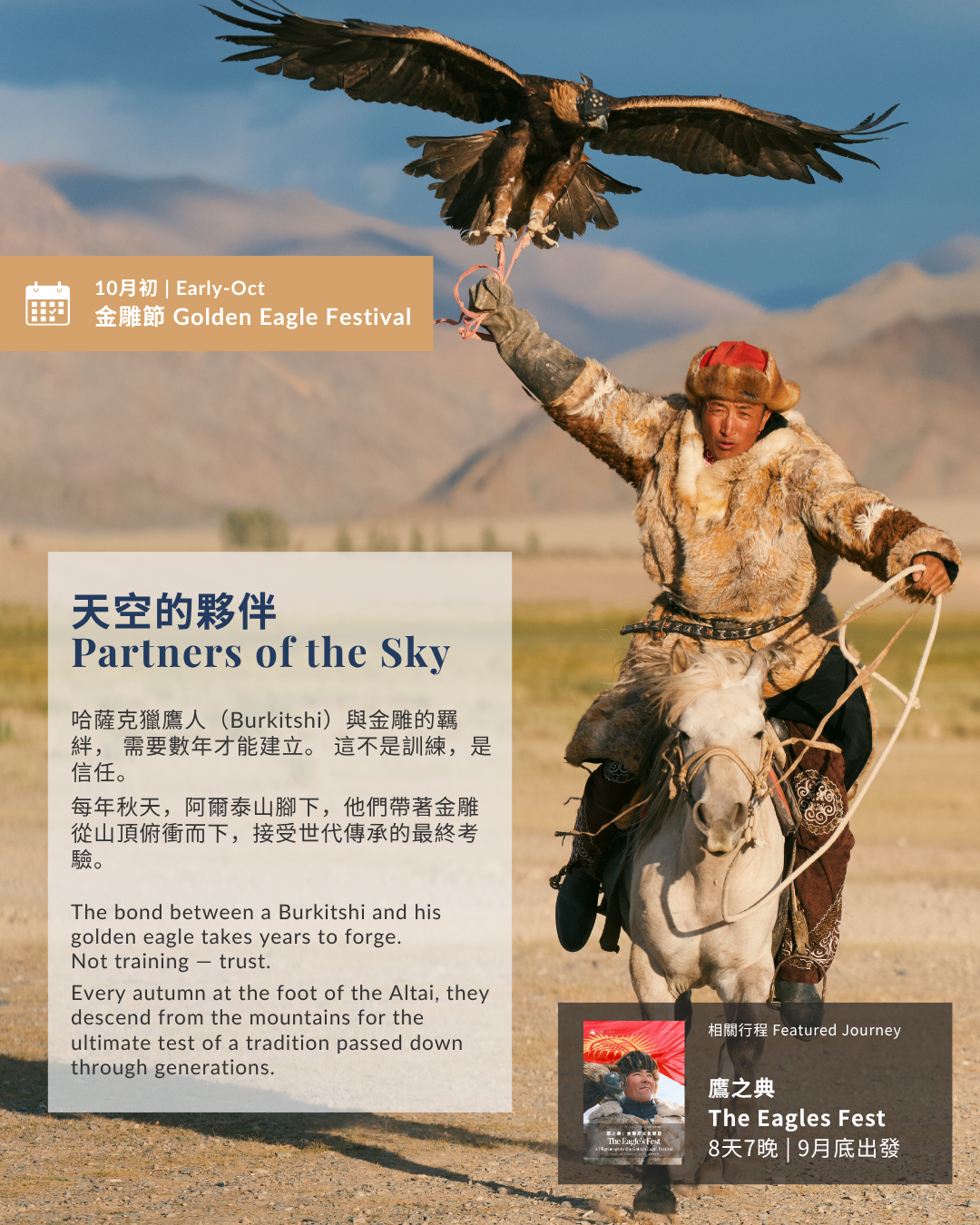
The bond between a Kazakh Burkitshi and his golden eagle takes years to forge.
Not training. Trust.
Golden eagles have wingspans exceeding two metres and dive at over 300 km/h. To have one land on your arm and respond to your call requires not dominance, but deep mutual understanding — the hunter learns the eagle's moods, habits, and needs; the eagle comes to know the human who feeds it, sleeps beside it, and carries it through the mountains.
Each autumn at the foot of the Altai, eagle hunters descend from the peaks for the ultimate test of a tradition passed down through generations. Judges assess not only speed and accuracy, but the wordless harmony between hunter and bird.
For the traveller: October light in the Altai is a photographer's dream — golden mountains, soaring eagles, hunters in traditional fur and embroidery. But more valuable than any image is sitting with a Burkitshi and hearing him describe the day he first met his eagle.
A Final Note
Every festival is a worldview made visible.
Mongolia's festivals are not designed for visitors. They are the ways in which the people of this land reaffirm their relationship with the sky, the earth, and each other — gratitude for the land, reverence for nature, commitment to tradition.
The traveller's role is simply this: arrive with humility, stay with curiosity, and leave having understood something you could not have found anywhere else.
Don't watch. Be there.
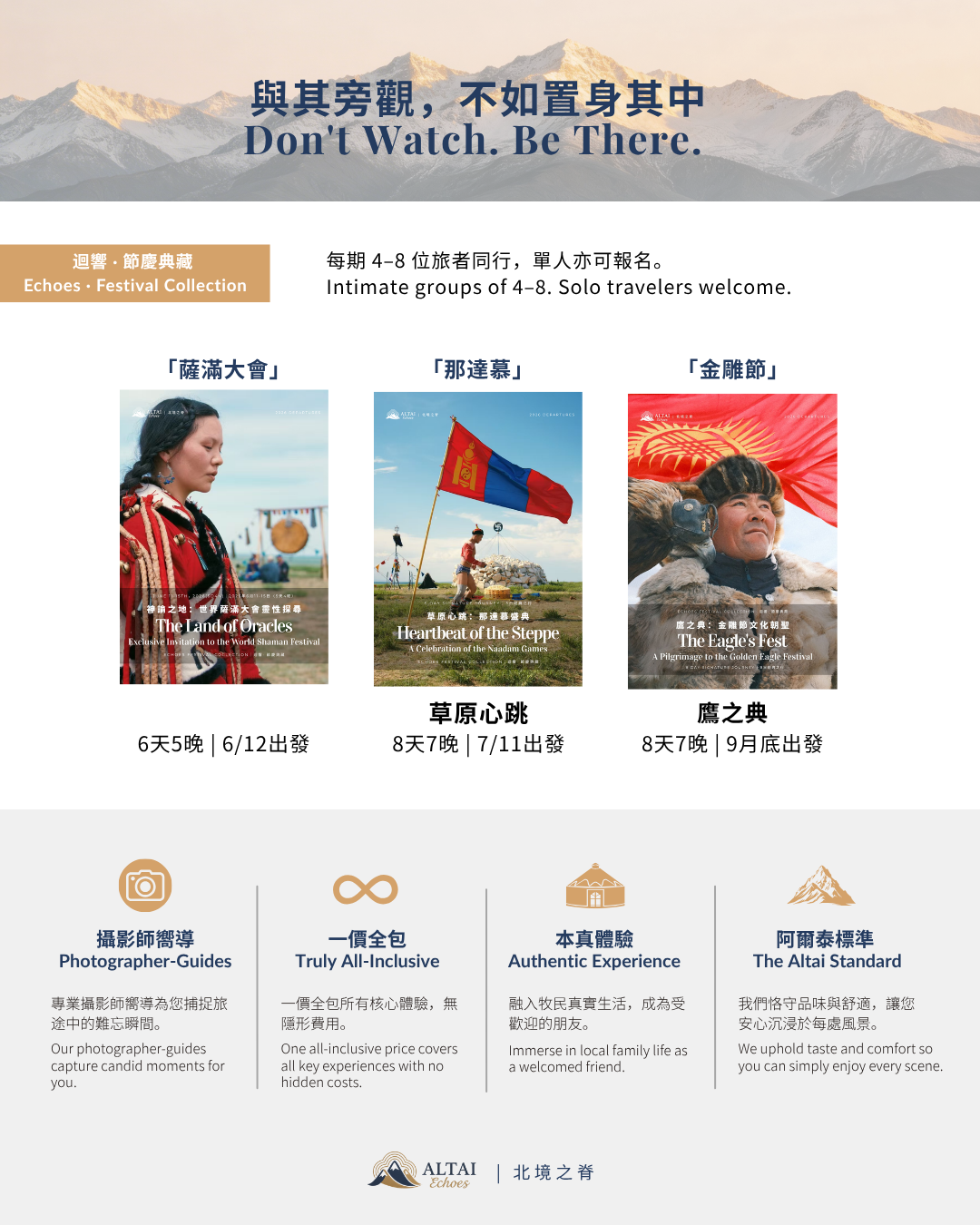
Altai Echoes offers three festival-centred journeys in 2026:
🥁 Land of Oracles Shaman Festival 6D5N June 12
🏇 Heartbeat of the Steppe Naadam 8D7N July 11
🦅 The Eagles Fest Golden Eagle Festival 8D7N Late September
Intimate groups of 4–8. Solo travellers welcome.