


At five in the morning, the steppe still sleeps.
A shamanic drum reaches you from somewhere in the distance — low, steady, rhythmic. Like the earth itself, breathing. Not a performance. Not a ceremonial overture. A summoning. You feel it before you hear it — a vibration in the chest, a resonance with something you cannot name. Something ancient stirs.
Some sounds have existed for thirty thousand years.

What Is Mongolian Shamanism?
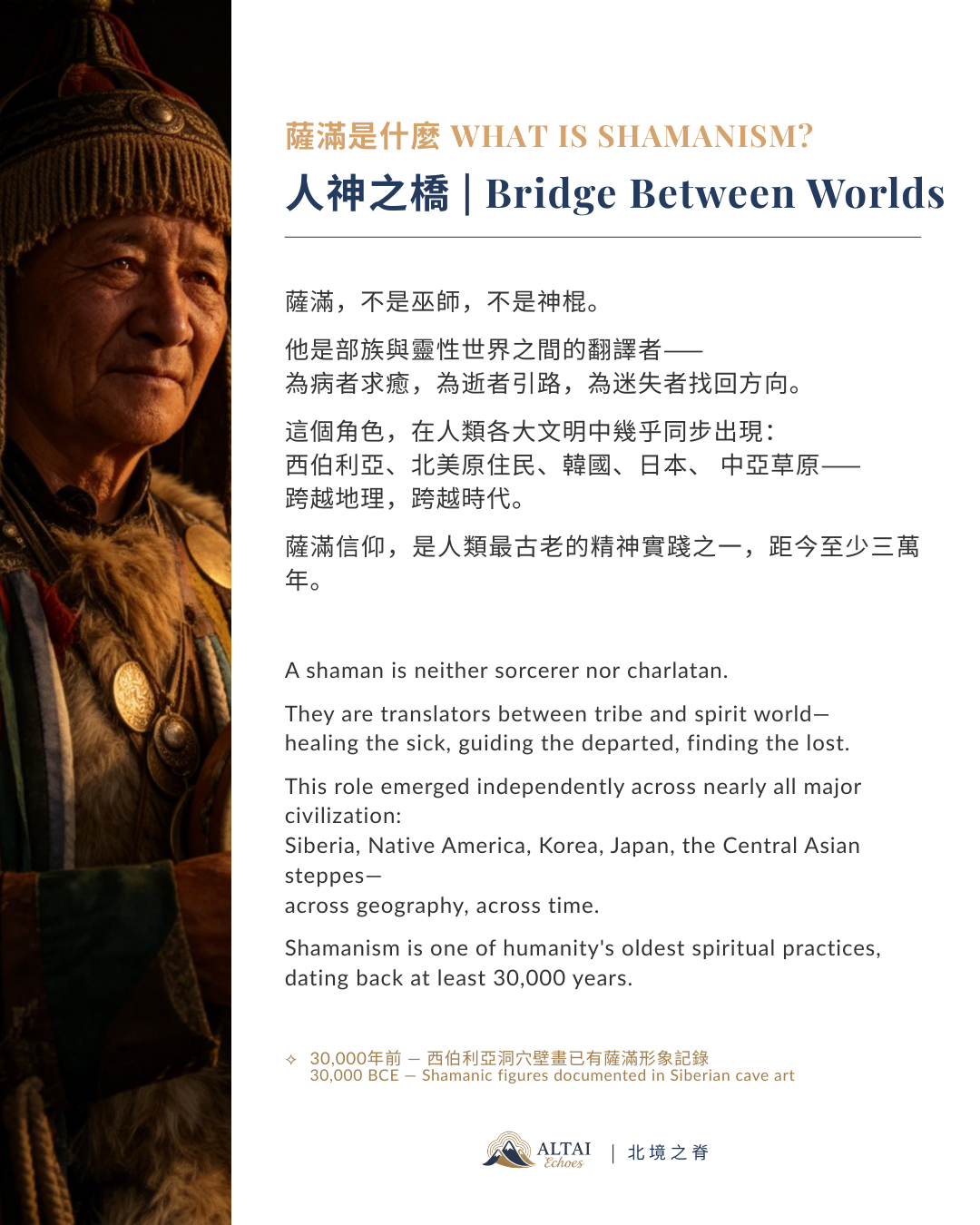
Mongolian shamanism — known locally as Böö Mörgöl — is one of the oldest spiritual traditions in human history, with archaeological evidence dating back at least 30,000 years. Unlike organized religions, it has no founder, no single scripture, no central institution, and no doctrine to follow. Its existence is closer to a mode of perception — a fundamental orientation toward the world.
Its core philosophy can be expressed in a single sentence:
Everything has a soul.
Mountains, rivers, wind, a stone, an ancient tree — all are living presences. Humans are not masters of nature, but participants within it. This worldview, known as animism, forms the philosophical foundation of shamanic practice across Central Asia, Siberia, and the broader Mongolian steppe.
This idea sounds simple, yet carries profound ethical implications. When a river has a soul, you cannot be indifferent to it. When a mountain is the home of ancestors, you cannot treat it with contempt. The shamanic worldview is, at its core, an act of humility — humility before life, before nature, before the forces that are real even when invisible.
Shamanism belongs to no single people or geography. From Siberia to the Americas, from the Sámi of Scandinavia to the mountain peoples of Southeast Asia, it has accompanied the full breadth of human civilization. Anthropologists believe shamanism may be the earliest spiritual system humans ever developed — predating any organized religion.
The answer is Mongolia.
The Three Realms: How Shamans Understand the Universe
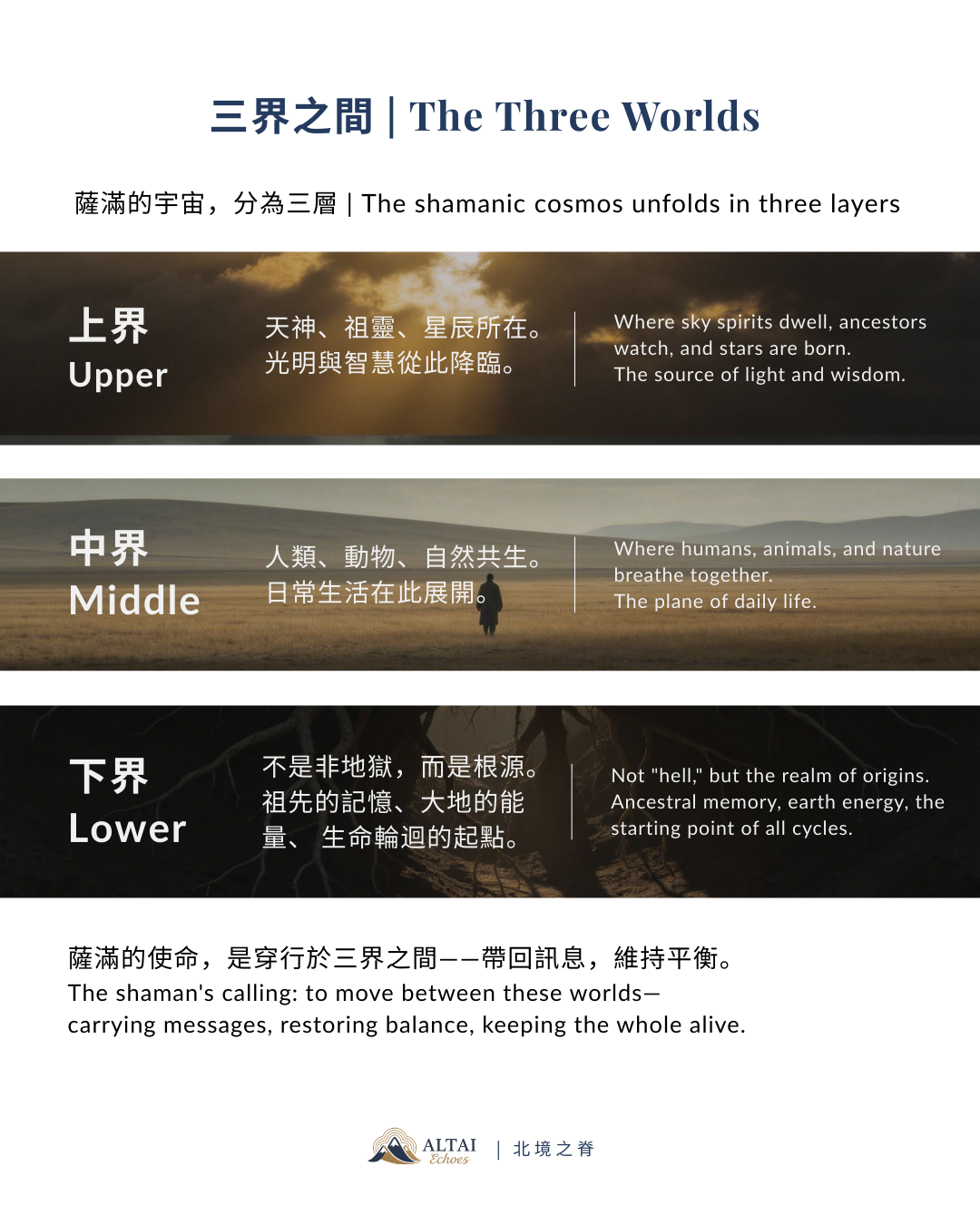
In the shamanic cosmology practiced across Mongolia, the universe is not a flat plane but a vertical, multi-layered structure. The cosmos is divided into three distinct realms, each with its own inhabitants, laws, and meaning:
- The Upper World — The realm of ancestral spirits and sky deities. The source of wisdom. The destination shamans travel to when seeking guidance. The Upper World is not an unreachable beyond — it is a space that can be entered through ritual.
- The Middle World — The world we inhabit. The layer where humans, animals, plants, mountains, and rivers coexist in a dynamic balance. When this balance is disrupted — by human greed, by illness, by natural disorder — the shaman is called to restore it.
- The Lower World — Not a place of punishment, but of origins. The repository of ancestral memory, the deep well of collective wisdom, the place from which life comes before it is born.
The shaman — known in Mongolian as Bo — serves as an intermediary between these three realms. They are not gods, nor prophets, but translators — rendering the language of the spirit world into something human communities can understand and act upon. Through ritual drumming, chanting, and trance states, the Bo travels between worlds to restore balance, seek healing, and carry messages from the spirit world back to the community.
This role is indispensable in any society the shaman inhabits. They are healer, mediator, keeper of history, and bridge between the community and the natural world. Their knowledge is not acquired from books but accumulated through years of apprenticeship, personal spiritual ordeal, and deep dialogue with nature.
The Shamanic Drum: An Instrument, a Universe
The shaman's primary ritual instrument is the drum.
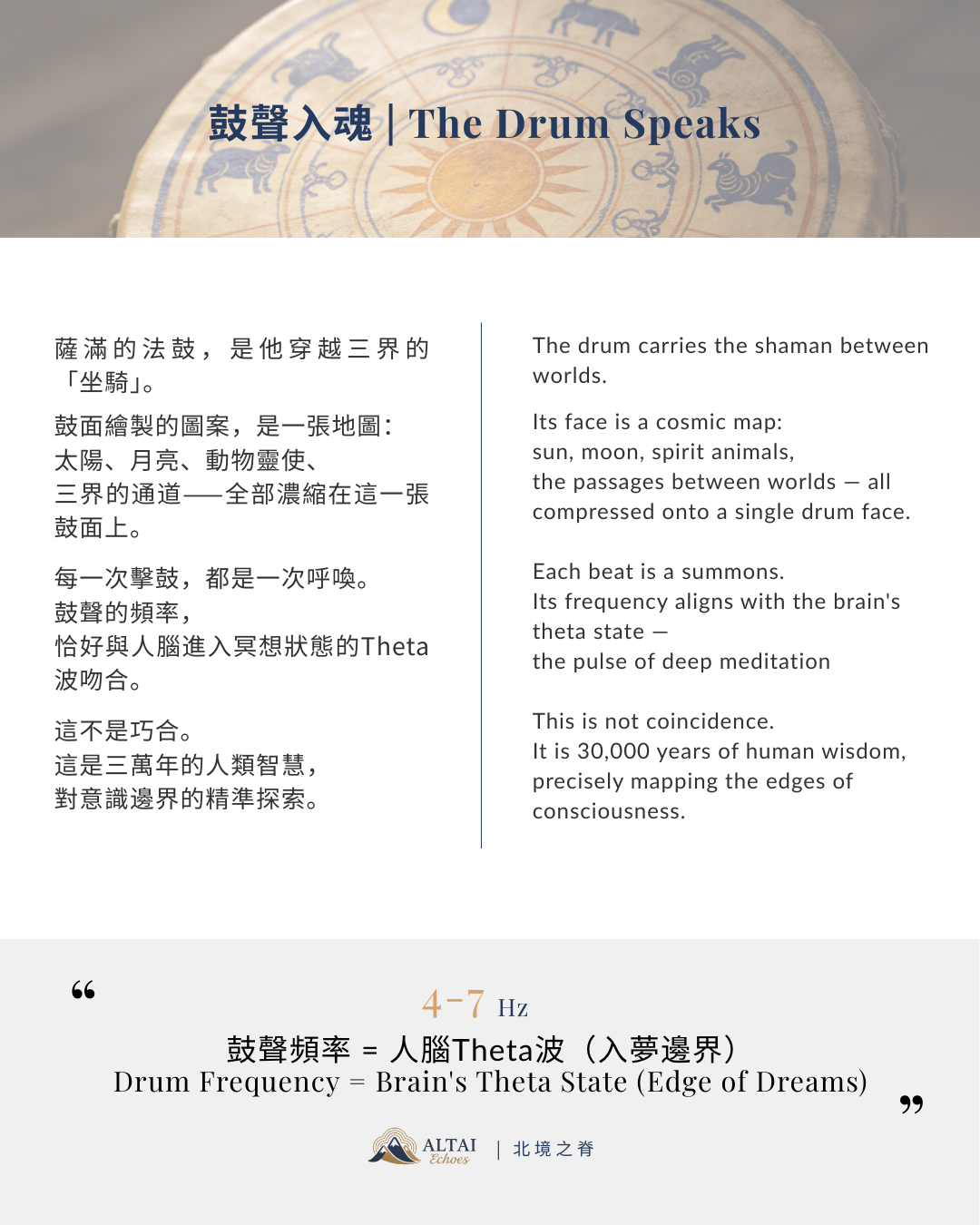
In Mongolian shamanic tradition, the drum is not merely an instrument — it is the shaman's “steed”, the vehicle through which they travel between the three realms. The drumhead represents the cosmos; the drumbeat represents the shaman's journey. Every shamanic drum is unique, handcrafted by the shaman using specific animal hides, and ritually imbued with a soul during its creation.
From a scientific perspective, this ancient instrument reveals a surprising precision.
Research has documented that shamanic drumming frequencies — typically between 4 and 7 Hz — correspond precisely to the theta brainwave frequency (θ-wave) associated with deep meditation, creative cognition, and altered states of consciousness in modern neuroscience.In other words: thirty thousand years before neuroscience, shamans had already developed a systematic method for guiding human consciousness into meditative states. They needed no EEG machines, no laboratory data. Only a drum, and millennia of accumulated wisdom.
This is not superstition. This is humanity's earliest neuroscience.

The Shaman's Regalia: A Moving Universe
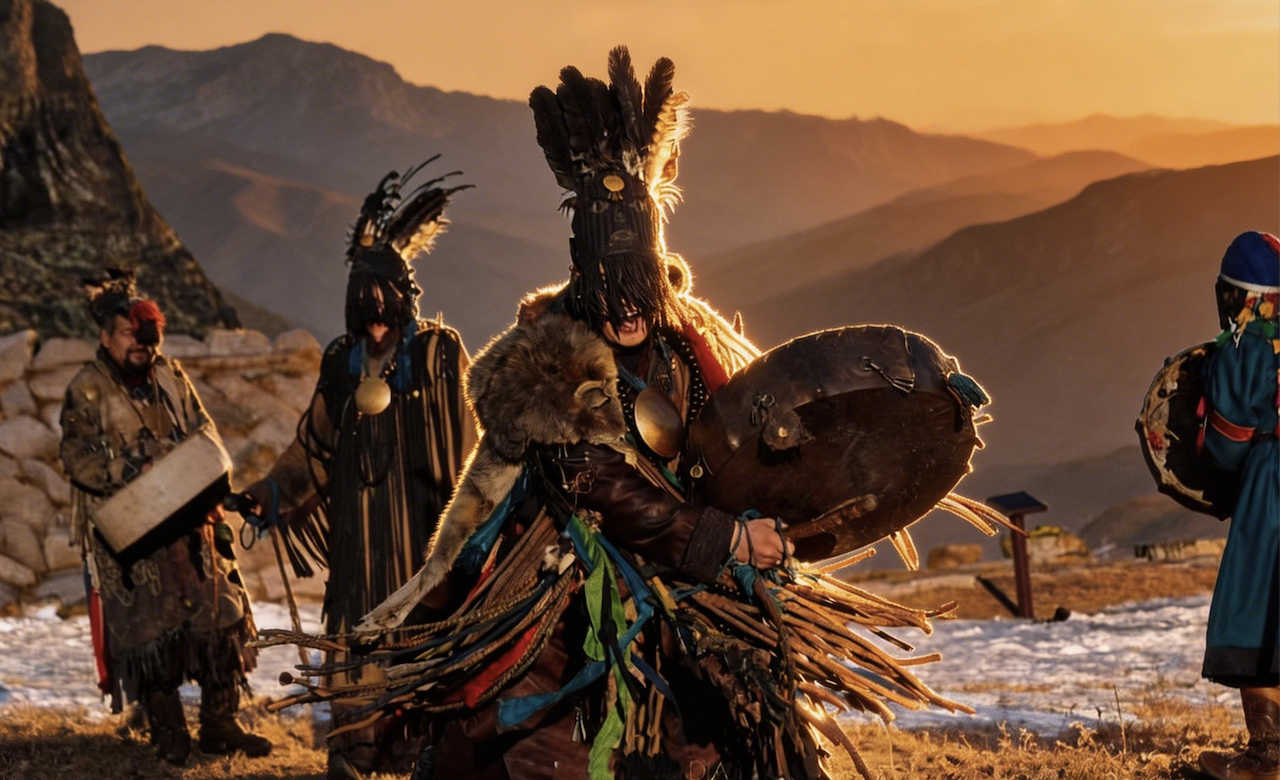
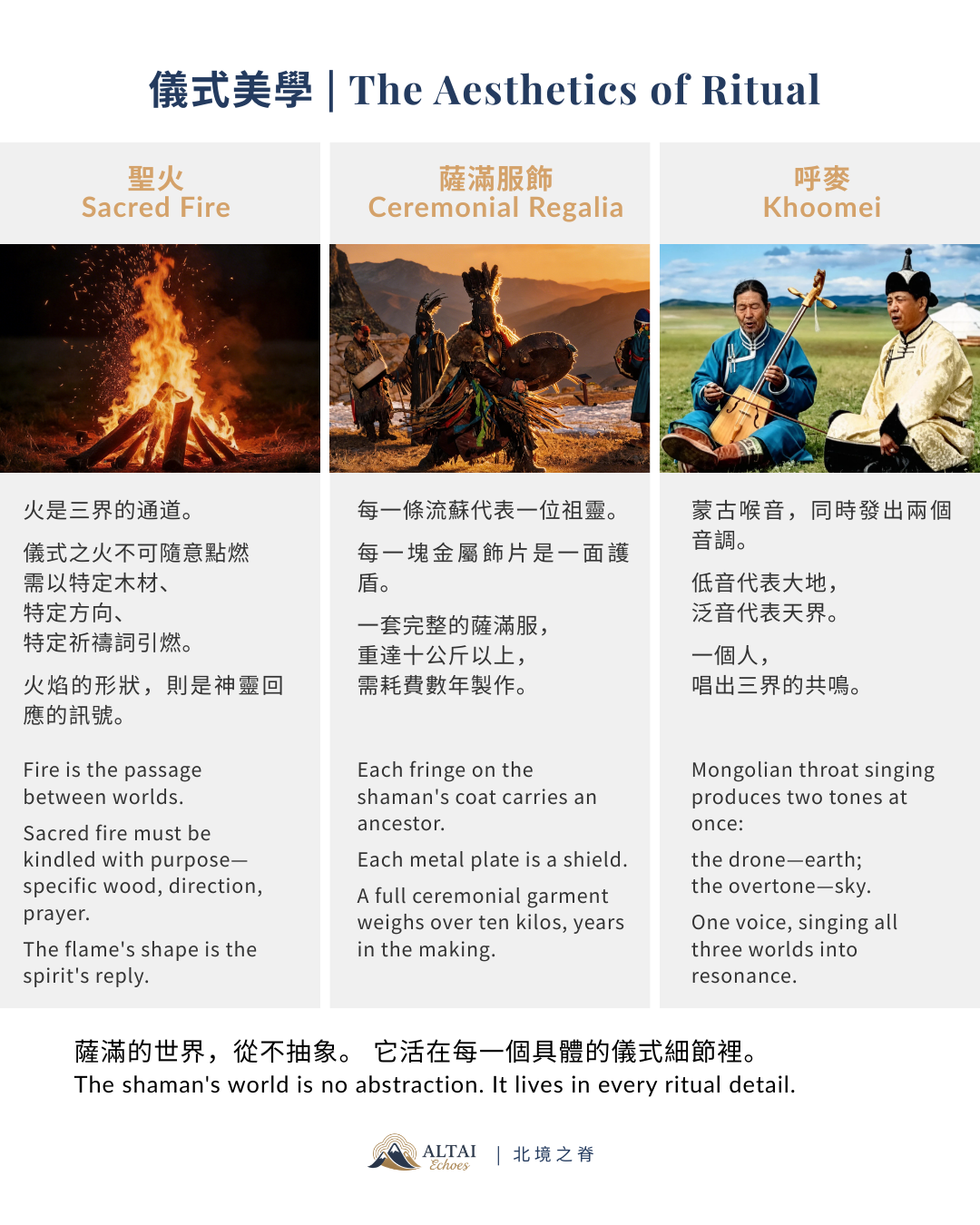
Approach a shaman dressed in full ceremonial regalia, and you encounter a moving cosmos.
The Mongolian shaman's ritual costume is a complex symbolic system, in which every element carries meaning:
- The Crown and Mask — Concealing the shaman's personal identity, allowing the forces of the spirit world to pass through. The feathers on the crown represent the ability to fly — the shaman's capacity to enter the Upper World.
- The Toli (Mirrors) — Metal discs sewn into the costume, used to deflect malevolent spirits and protect the shaman during their spirit-world journeys.
- Fringes and Streamers Representing the shaman's connections to the spirit world. Each streamer may represent an ancestor or a guardian spirit.
- Animal Elements — Antlers, bear claws, bird feathers. By wearing these elements, the shaman summons the power and wisdom of the corresponding animals.
A complete shamanic costume can weigh tens of kilograms and may take years to complete. For the shaman, putting it on is an act of transformation — no longer an ordinary person, but an emissary of the three realms.

How Did Mongolian Shamanism Survive?
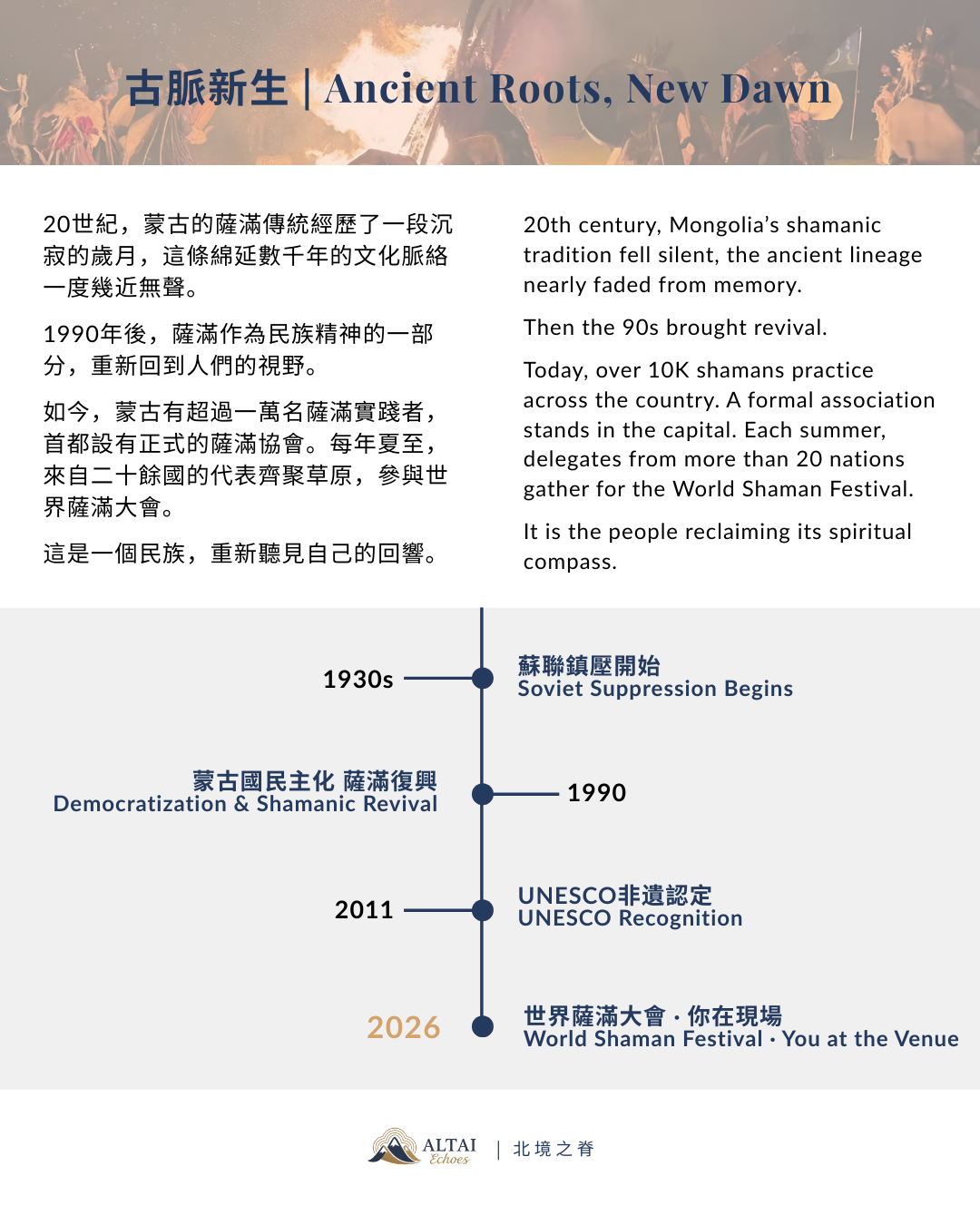
The 20th century presented severe challenges to shamanic practice across Mongolia. Many public rituals were suppressed. Shamanic schools were closed. Formal transmission became extraordinarily difficult. In that era, becoming a shaman required extraordinary courage.
But the tradition was never extinguished.
Elder shamans preserved their knowledge in the most ancient way possible — through family lineage, through oral transmission. Rituals, cosmologies, chants, herbal knowledge — passed in the quiet of a ger at night, from grandfather to grandchild, from mother to daughter. This mode of transmission appears fragile, yet possesses remarkable resilience. It depends on no institution, requires no building — only the trust between people, and a love for this land.
When Mongolia opened politically in the 1990s, shamanism experienced a powerful revival. A tradition suppressed for decades resurfaced with astonishing speed. Shamanic associations were established. A younger generation began searching for their roots. Rituals rang out across the steppe once more.
Today, Mongolia is home to more than 10,000 practicing shamans, organized across multiple recognized associations and lineages. In Ulaanbaatar, shamanic clinics operate openly — people seek spiritual consultation there as naturally as they might seek psychotherapy in a Western city.
The tradition is not a relic. It is a living, evolving practice, holding an irreplaceable place in contemporary Mongolian society.
The World Shaman Festival: Earth's Most Magnificent Spiritual Gathering
What Is the World Shaman Festival?
The World Shaman Festival is the world's largest gathering of intangible cultural heritage, held annually in Mongolia around the summer solstice. In 2026, the dates are June 12–15.
The venue is Khui Doloon Khudag — the traditional sacred ground of Naadam, located 30 kilometres south of Ulaanbaatar. During the festival, this vast wilderness is transformed into a city of souls — a natural field for communicating between heaven and earth.
Shamanic delegations from over 20 countries — including Tuva, South Korea, the United States, Hungary, Japan, and the various peoples of Siberia — arrive with their tribal totems. This is not a single culture on display, but a grand convergence of the entire human shamanic tradition: a magnificent anthropological tapestry.

2026 Programme Highlights
Each ceremony carries deep symbolic weight:
- Sun-Welcoming Ceremony (5:30 AM) — A hundred shamans drum simultaneously at the first light of dawn, witnessing the primal vibration of faith upon the land. Drumbeat and sunrise arrive together. In that moment, time seems to stop.-
- Global Totem Procession — Shamans from every delegation enter in full ceremonial regalia, carrying sacred banners. Each banner represents a lineage, a history, a land's memory.
- Collective Blessing Ceremony — Drums and prayers interweave, rising for the earth and for every person gathered. When dozens of shamans chant simultaneously, you feel the air itself vibrate.-
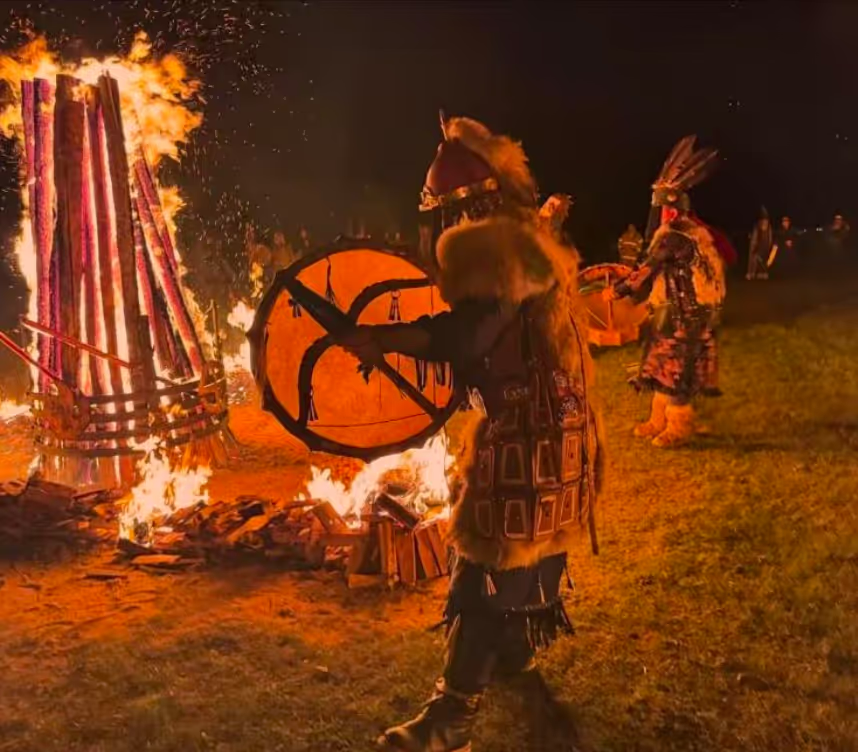
- The Great Fire Ritual (9:00 PM) — Sacred flames rise. Drums pulse like a second heartbeat. Fire like rebirth. On the open steppe at night, firelight illuminates every face. This is the energetic climax of the entire festival.-
- Peace Prayer — A collective spiritual resonance from shamans worldwide, for environmental restoration and global harmony. In an era of conflict, this ceremony carries a universal meaning that transcends culture.
This is not a performance staged for tourists. It is a genuine, active spiritual assembly — a real ritual space where the boundary between audience and participant dissolves, and every person present becomes part of the ceremony.
How to Experience Mongolian Shamanism Authentically
The Distance Between Watching and Belonging
Most people's understanding of shamanic culture remains at the surface: a video watched, an article read, perhaps a "performance" seen at a tourist site.
But the heart of shamanic culture was never meant to be watched. It was meant to be felt.
Authentic engagement with Mongolian shamanism requires more than observation. It requires cultural context, trusted local relationships, and the ability to participate — not merely watch. Without these, you see only the form, not the essence. You see the drum, but cannot hear what it is truly saying.

Altai Echoes Spirit Quest Journey
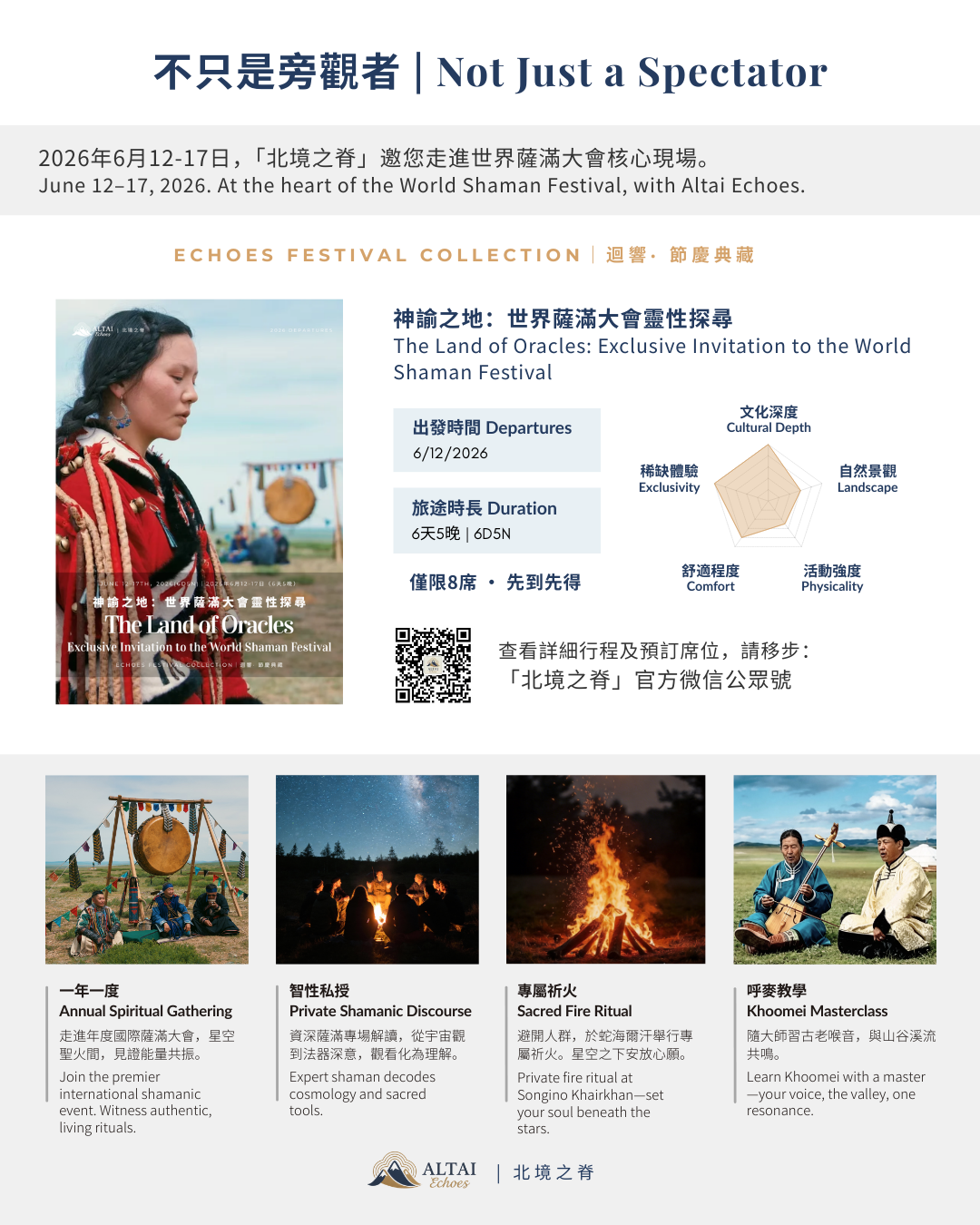
Altai Echoes' Spirit Quest journey — The Land of Oracles: Exclusive Invitation to the World Shaman Festival — is designed specifically for this depth of access. This is not a tourism product. It is a cultural homecoming — designed for those who want to truly understand, not merely document.
The journey spans 6 days, limited to 8 voyagers, and offers the following exclusive experiences:
- Private Shamanic Philosophy Masterclass Leaving the intensity of the festival grounds, we retreat to a sacred camp at the foot of Sharkhai Khan Mountain for a closed-door session designed exclusively for Altai Echoes voyagers. Led by a senior shaman, the masterclass covers the three-realm cosmology, lineage systems, the role of the Bo in contemporary Mongolian society, and the implications of shamanic philosophy for modern life. This is not an academic lecture — it is a genuine dialogue. You may ask, challenge, and share your own uncertainties.
- Full World Shaman Festival Access Attendance at the opening ceremony and all core rituals — including the Sun-Welcoming, the Global Totem Procession, the Collective Blessing, and the Great Fire Ritual. Bilingual cultural interpretation is provided throughout, ensuring you not only witness but truly understand the meaning of each ceremony.
- Exclusive Sacred Mountain Fire Ritual Through Altai Echoes' long-standing relationships with local shamanic communities — built over years of mutual respect, not financial transaction — we arrange a private ceremony for our voyagers on sacred ground. Sit around the fire. Listen. Feel. Speak if you are called. This is the moment you truly belong to the night — and an access that most outsiders will never obtain.
- Private Khoomei (Throat Singing) Masterclass In a mountain valley, a one-on-one session with a Khoomei master. Throat singing is an ancient vocal technique used on the Mongolian steppe for centuries — capable of producing two pitches simultaneously, a fundamental tone and an overtone, mimicking the sounds of nature: wind, flowing water, the open steppe. Learning Khoomei is not merely learning a technique. It is learning a way of listening.
Journey Details
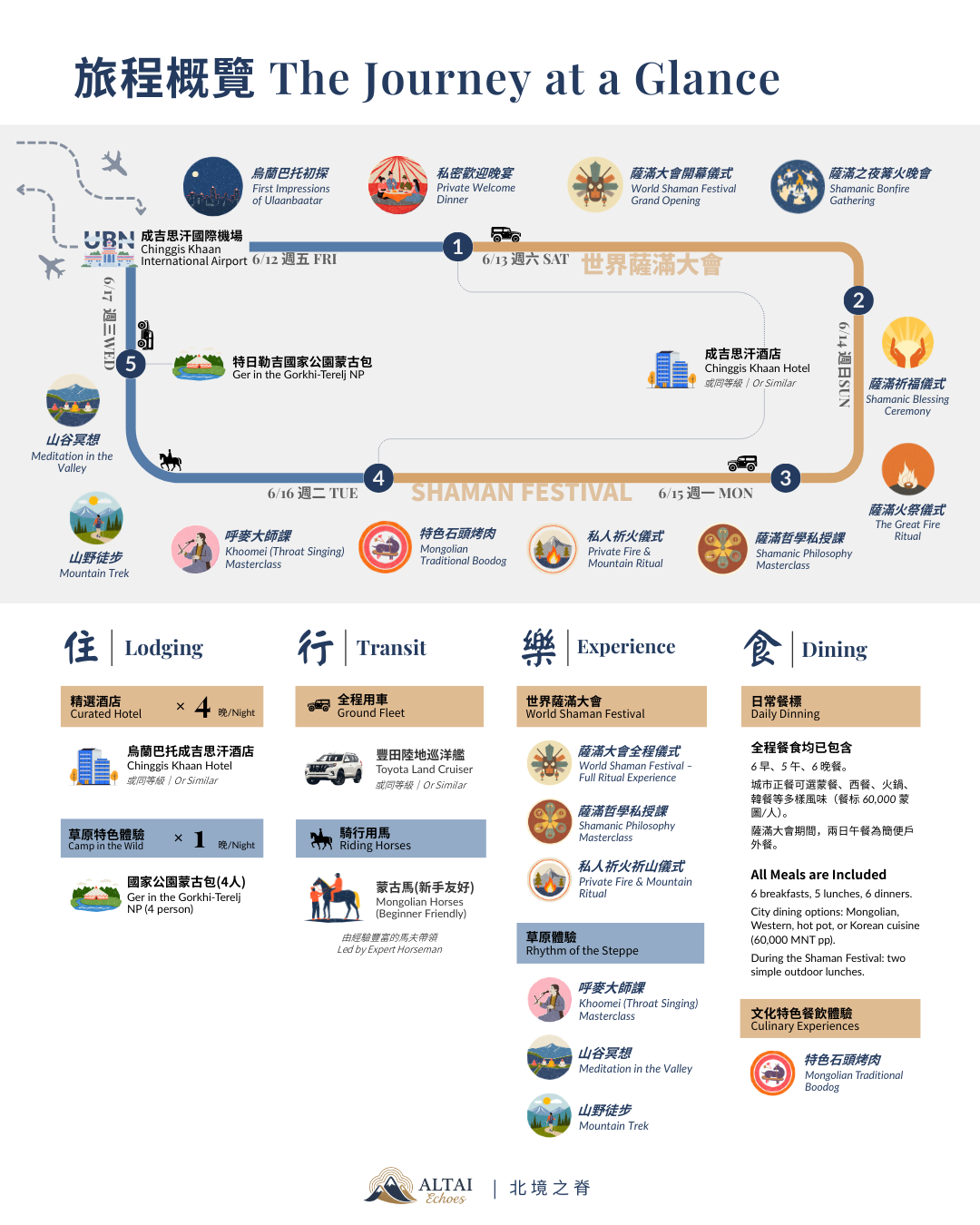
- Departure: Ulaanbaatar (Airport transfers are provided)
- Accommodation: 4 nights at a 4-star city hotel (Chinggis Khaan Hotel or equivalent) + 1 night in a premium steppe ger-
- Transport: Toyota Land Cruiser or equivalent, private throughout-
- Guides: Professional photographer-guide, bilingual (Chinese/English)-
- Investment: HKD 24,800/USD 3,200 per person (includes visa processing, all meals, all activities)
- Group Size: Maximum 8 voyagers per departure
Frequently Asked Questions
Is the World Shaman Festival a real ceremony or a tourist performance?
The World Shaman Festival is a genuine annual gathering, held regularly and entirely independent of the tourism industry. Altai Echoes brings you into the core of this real assembly — not its peripheral tourist zones. The private masterclass and exclusive fire ritual we arrange are access points obtainable only through long-term local relationships — impossible to replicate by any tourism product.
Is it respectful for outsiders to participate in shamanic ceremonies?
Yes — with the right guidance and the right attitude. Altai Echoes works exclusively with shamanic communities who have chosen to open certain ceremonies to respectful outside participants. We never observe without permission, and we never commodify sacred practice. Our local relationships are built on years of mutual respect, not financial transaction.
I have no religious beliefs. Is this journey suitable for me?
Absolutely. Shamanism is a philosophy of nature, not a religion. It requires no belief in any particular deity or doctrine. This is an inward journey — regardless of your beliefs, you will find your own echo in the drums and the wild. Many of the voyagers who have joined this journey are committed rationalists or agnostics. What they take home is not a religious conversion, but a new way of perceiving.
What is the best time to experience Mongolian shamanism?
The summer solstice period (June) coincides with the World Shaman Festival and offers the richest concentration of shamanic activity. Altai Echoes' Spirit Quest journey is scheduled accordingly — the 2026 departure date is June 12.
What is the accommodation like? Is there hot water?
Deep culture does not mean physical hardship. Four nights in a 4-star city hotel, one night in a premium steppe ger, private transport throughout, and bilingual guides — seamlessly balanced between wilderness and comfort. We believe the best travel experiences open the mind fully, without exhausting the body unnecessarily.
How is Altai Echoes different from other Mongolia travel operators?
Altai Echoes was founded by individuals with Inner Mongolian heritage. We are not outsiders looking in — we are cultural insiders, leading every voyager into an authentic Mongolia through a perspective that cannot be replicated. Our guides are not translators; they are cultural interpreters. Our itineraries are not schedules; they are carefully designed pathways into culture.
Jung once wrote
"Modern man does not understand how much his rationalism has put him at the mercy of the psychic underworld."
In the Altai, time moves differently. The drumbeat travels across the steppe, unconstrained by any border. Firelight illuminates faces from twenty countries, and every face carries the same expression — not wonder, but recognition. As if something long forgotten has suddenly been remembered.
Here, you are not a passerby — but a witness to timeless landscapes, and a carrier of ancient wisdom.
It is an outward journey that leads inward.
Related Journey

The Land of Oracles
World Shaman Festival · Exclusive Expedition
Every summer solstice, shamans from 20+ nations gather on the Mongolian steppe. A closed-door philosophy masterclass, a private fire ritual beneath the stars, a Khoomei lesson in a mountain valley. Eight seats. For those who want to truly understand.
Altai Echoes Product Team